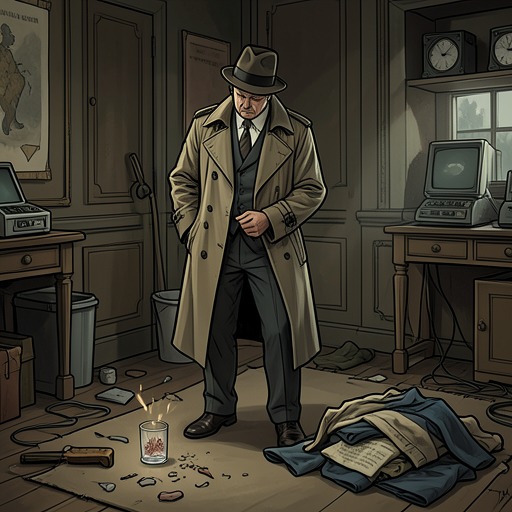
The semen specimen Kumagai submitted for testing
Presumed InnocentThe semen specimen Kumagai submitted for testing became a pivotal piece of forensic evidence against Rusty Sabich—and, under cross-examination, a point at which the prosecution’s confident narrative could no longer rest on certainty about the sample’s origin. Its reported chemical contents helped support Dr. Kumagai’s reconstruction of events, but his inability to remember handling it left open a consequential possibility: the specimen identified as coming from Carolyn Polhemus might not have been hers.
Role in the Forensic Account
During his testimony for the prosecution, Dr. Kumagai considered the specimen alongside other forensic information, including the forensic chemist’s analysis and blood-test results. He was presented not simply as a witness to one observation, but as an expert expected to assess the evidence and offer an opinion about what had happened. The specimen’s significance therefore depended on how its laboratory findings fitted into a broader reconstruction.
The analysis identified the specimen as associated with the blood type attributed to Rusty Sabich and as containing chemicals consistent with the use of a diaphragm. The reported presence of spermicide, including nonoxynol-9 and jelly bases, was central to Dr. Kumagai’s account of recent intercourse and his interpretation of Carolyn Polhemus’s circumstances on April 1. These findings gave the sample evidentiary force beyond the mere fact that biological material had been collected: its supposed source and its chemical composition were both necessary to the conclusions drawn from it.
Dr. Kumagai also used the findings in a wider interpretation of the scene. In his view, the chemical evidence, considered together with the fact that doors and windows had been left unlocked, suggested that the appearance of a sexual assault had been staged to conceal the murderer’s identity. He further reasoned that the person responsible knew about methods of crime detection and Carolyn Polhemus’s routine responsibilities in the prosecutor’s office. Those were expert inferences, not direct observations of the person who committed the crime. Because the specimen’s contents helped support the reconstruction, uncertainty about its source would affect more than one isolated detail.
The Sample’s Place in the Prosecution’s Case
The prosecution’s interpretation connected the reported spermicide to diaphragm use and then incorporated that interpretation into its account of what had occurred shortly before Carolyn Polhemus’s death. In questioning Dr. Kumagai, Sandy Stern made the dependency explicit: the conclusions at issue relied substantially on spermicide being present in the specimen submitted for testing. The sample was thus a hinge in the forensic chain. Its laboratory result mattered because the prosecution treated it as material taken from Carolyn Polhemus during the autopsy.
That chain also connected the sample to Rusty Sabich. The prosecution’s questioning emphasized that the specimen had been identified as matching his blood type, while its chemical contents were used to support the inference about diaphragm use. Taken together, those features appeared to fit the prosecution’s account. But they could point toward Rusty Sabich only if the specimen had first been correctly collected and attributed to Carolyn Polhemus. The distinction between what the laboratory found in the submitted material and where that material actually came from became the central issue in Stern’s challenge.
Disclosures to Tommy Molto
The sample’s handling was also entangled with communications among the people involved in the investigation. Dr. Kumagai acknowledged that he had discussed the case with Tommy Molto, describing their conversations as involving public information rather than grand-jury material. When asked specifically whether he had told Tommy Molto the forensic chemist’s result about the specimen containing spermicide before conveying that result to Rusty Sabich, he answered that he thought he had.
That answer placed Tommy Molto’s access to the result within the trial’s examination of the evidence. It established that Dr. Kumagai believed he had communicated the finding to Tommy Molto before discussing it with Rusty Sabich; it did not, by itself, establish that the specimen had been mishandled or that the analysis was false. Its importance lay in showing that the forensic result had circulated through conversations as well as through formal testimony, making the history and reliability of the evidence relevant to the courtroom dispute.
Stern’s Challenge to Provenance
Sandy Stern’s cross-examination shifted attention from what the chemist had detected to whether Dr. Kumagai could personally verify the sample’s identity. Stern raised the apparent absence of spermicide in Carolyn Polhemus’s apartment and asked whether that made it clear she had not used a spermicide on April 1. Dr. Kumagai declined to answer that question. Stern then confronted him with the possibility that the specimen sent to the chemist had not been taken from Carolyn Polhemus’s body.
Dr. Kumagai initially referred to having a regular procedure. Stern pressed the difference between following a routine and remembering this particular collection. Dr. Kumagai acknowledged that he had no clear recollection of taking the specimen, marking it, and sending it on. When Stern asked whether the spermicide-containing specimen identified with Rusty Sabich’s blood type might not have come from Carolyn Polhemus, Dr. Kumagai eventually accepted that this was possible. He did not claim to know that the sample was misidentified; his concession exposed that he could not rule out the possibility from personal recollection.
Evidentiary Consequence
The concession weakened the certainty with which the specimen could serve as a link between Carolyn Polhemus, the chemical findings, and Rusty Sabich. It did not establish that the specimen came from someone else, nor did it erase the laboratory results. Rather, it separated two propositions the prosecution’s account had joined: that the submitted material contained spermicide and was associated with Rusty Sabich’s blood type, and that the material had been collected from Carolyn Polhemus. The first could be reported as a test result; the second depended on collection and identification that Dr. Kumagai could not clearly remember.
The moment also altered the specimen’s function in the trial. Before Stern’s questioning, it had helped organize an apparently coherent forensic explanation. After Dr. Kumagai admitted uncertainty about its source, the same object embodied a gap in the chain connecting analysis to the body from which the material was said to have come. His testimony did not resolve that gap. It made the limit of his knowledge part of the evidence, leaving the jury to consider how much weight the prosecution’s reconstruction could bear when one of its crucial samples might not have originated where the prosecution said it did.